You know the possession. A guard dribbles to the wing, swings it, swings it back, and eight seconds later somebody takes a contested three because the zone just sat there and nobody wanted to make a decision. The zone did not beat you. You kept the ball on the perimeter, where a 2-3 is strongest.
Where a 2-3 is thin
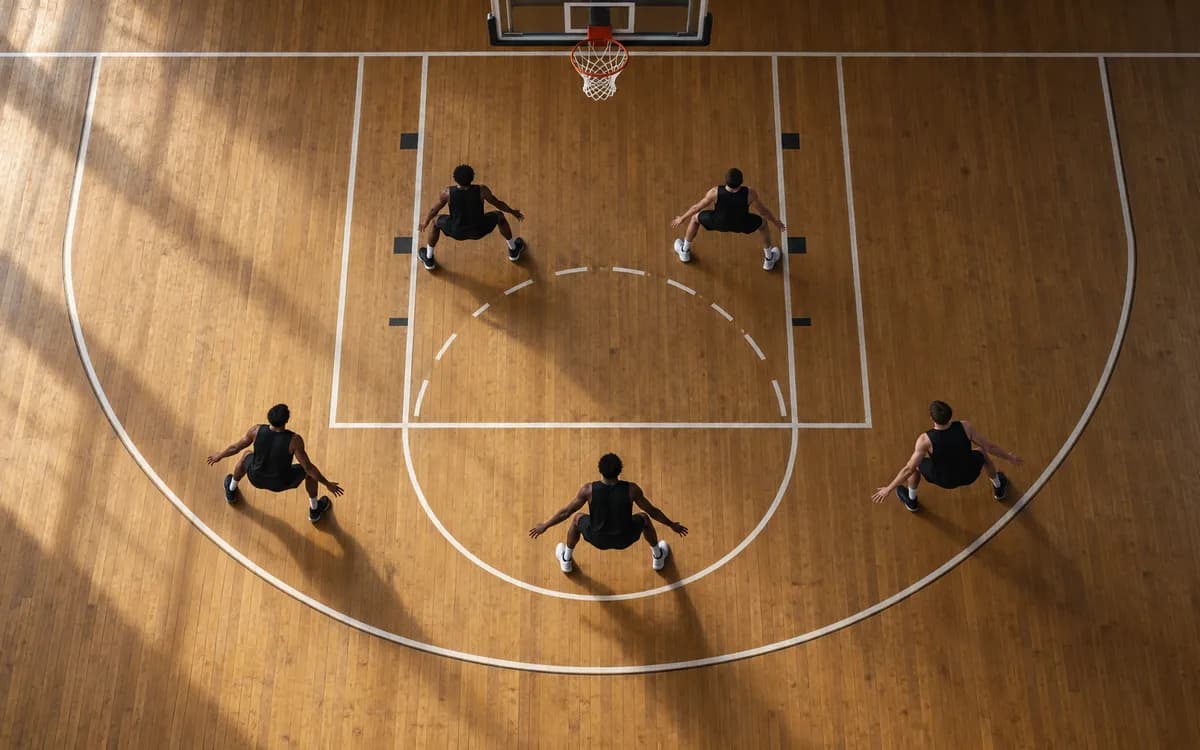
A 2-3 has two guards up top, two wings and one defender in the middle behind them. Look for the spots that belong to nobody for a second: the high post at the free-throw line, and the short corner, which is the baseline spot about ten feet from the rim. Both sit between defenders' areas. When the ball gets to either one, somebody has to leave their spot, and whoever leaves opens a different one.
The read starts at the high post
In Short Corner Flood, 4 flashes to the free-throw line as the ball swings to the wing. His first read is not a shot. He catches facing the rim and looks at the middle defender. If that defender steps up to meet him, the short corner behind is open. If the defender stays home, 4 can shoot the 12-footer or turn and attack the gap.
Give your 4 one coaching point: eyes on the rim, not on the ball. Players who stare at the ball miss the middle defender's first step, and that step is the whole read.
The short-corner player decides the possession
The short corner is the harder job. Your 5 stands right behind the bottom defender, who can see him and the ball. So he does not stand still. He starts on the baseline side of that defender, hands ready, and slides into the open spot the moment the high-post ball arrives. A late slide gets the pass stolen. An early slide tells the defender to stay with him.
From there he has three answers: shoot the ten-footer, make a quick move toward the baseline, or find the weak-side slasher. That slasher is 2 in our diagram, and he cuts the baseline because the back-side defender is watching the ball. Teach 2 to cut as the pass is thrown to the short corner, not after it lands.
Do not teach the zone's weakness as a play. Teach it as a question: what did the middle defender just do?
Three habits that make it work
- Skip the second swing. If the first pass to the wing gets the zone moving, play the high post right away. Every extra swing gives the zone time to reset.
- Keep the wings wide. Shooters who drift toward the middle pack the zone together and take away both reads.
- Make the zone pick. If the bottom defender sits on the short corner, do not force the pass. Hit the high post, then reverse the ball.
What a good zone coach does back
Expect an adjustment by the second quarter. Some coaches will have the middle defender sit at the free-throw line to deny the high post. That gives you the gap at the top, and Zone Gut is built for it: attack the space between the two guards with the dribble and kick it to whoever the stepping defender left.
Others extend the wings high to take away the swing. Then the corner is empty behind them, and Baseline Runner puts a shooter there off a screen on the bottom defender. Run all three and the zone cannot cheat in any one direction.
A 12-minute way to practice it
- Four minutes of 5-on-4 against a zone shell. The offense scores only after the high post touches the ball.
- Four minutes of live 5-on-5. Give a point for every possession that reaches the short corner, whether it scores or not. You are paying for the right read.
- Four minutes of free play. Let the defense choose its adjustment, and let your players find the answer from the three above.
After the game, tag your zone possessions on film. Mark which pass broke the zone and which one it did not. A season of that tells you more about your own team than any scouting report. In Hoops ClinIQ you can link each clip to the play it came from, so the same reads show up in your playbook and your film.