Every press break looks fine on the whiteboard. Throw it in, get it to the middle, advance. Then the game starts and your guard catches the inbound, takes one dribble, and gets trapped on the sideline with a defender in each ear. The first pass was not the problem. The second one was late.
The window is short
A trap needs two defenders to close on the ball handler. From the moment the first pass is caught, that takes a second or two in most youth games. If your next pass leaves the guard's hands after that, you are throwing over arms into a crowd. If it leaves before, the trapper is a step away from where he wants to be, and the middle is open.
So the second pass is a timing problem. It is not a problem of vision or skill. You can teach timing.
The three parts
- The catch. The guard catches the inbound and faces the court. He does not dribble first. A dribble on the sideline tells the defense where he is going.
- The middle flash. A teammate steps to the middle of the court the instant the inbound is thrown. He is early on purpose. A late flash arrives with the trap.
- The release. The guard passes to the middle flash before the second defender gets there. If the trapper is already on top of him, he does not pass. He pivots and takes the sideline pass.
What the flash player reads
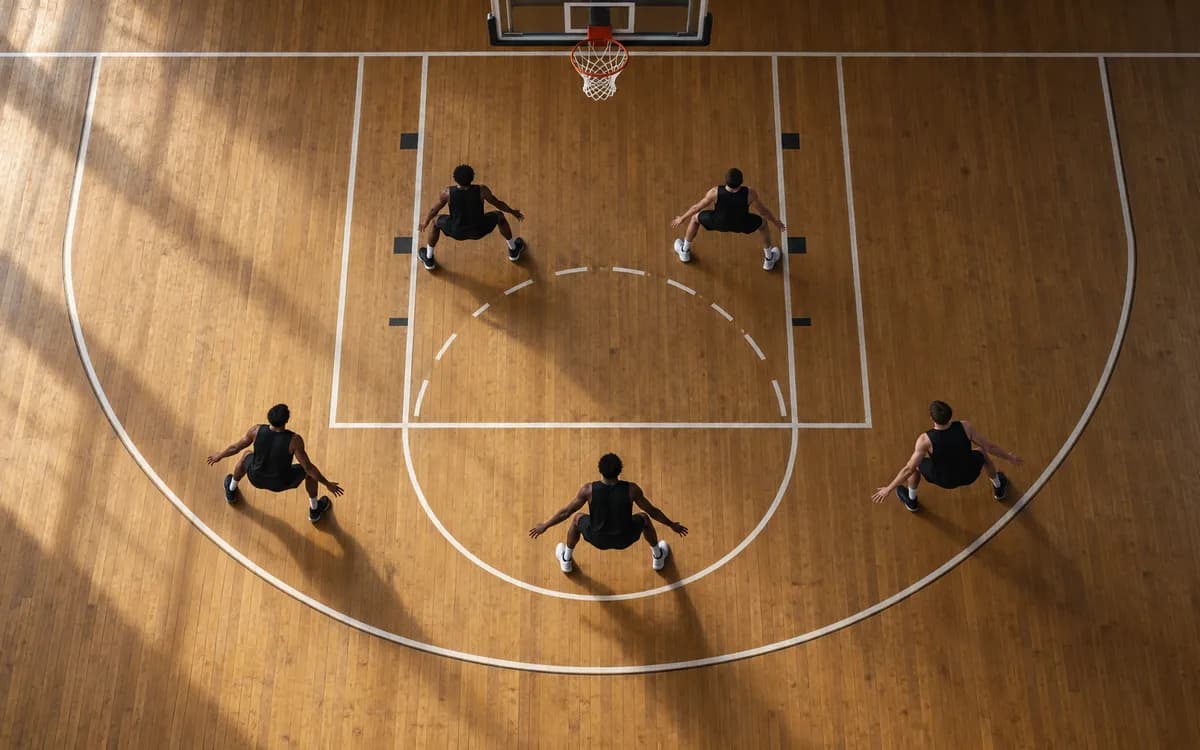
The middle player catches facing the basket. His eyes go to the streaking wing first. The defense just committed two players to the trap, so somebody downcourt is outnumbered. If the wing is open, he passes right there. If a safety steps up, he dribbles at the safety and the 2-on-1 comes from the side. In our diagram, that is the attack with 3 and 5 filling lanes.
The press is not beaten by the player who catches it. It is beaten by the player who moves before the ball is thrown.
Three mistakes we see on film
- The flash starts after the catch. By then the trap is closed. Teach players to start on the inbounder's arm, not the ball.
- The guard dribbles toward the trap. A dribble into the sideline loses the angle. Pivot away instead.
- The wings jog. If the wing is not already running when the middle player catches, the 2-on-1 turns into a 2-on-2.
Practice it in short bursts
- Walk-through. Five players, no defense. Count out loud, "catch, flash, release", until the timing is easy.
- Two defenders trap, offense has the inbound, everyone at 50 percent speed. Stop after every rep and ask where the flash started.
- Full speed, five on five, three possessions per group. Count only the possessions that cross half court without a turnover. Stop at five clean ones.
Ten minutes a week is enough. Press breaks are timing, and timing needs reps more than it needs long sessions.
Who should be the middle player
Not always your best guard. Pick the player who catches in traffic and does not panic: usually a forward with good hands and a quick first look. Give him one job on the rep, which is to catch and see the floor. A player with two jobs does neither. Your best ball handler can wait on the sideline for the pivot-and-pass option.
When the press changes
If the other team traps the first pass, the inbounder steps in for a return pass. If they deny the middle, throw it to the side and flash the middle again. The two counters are in the library entry. If you are inbounding from the sideline, Sideline OB gives you the same safe-catch-first idea.
After a game, tag every press possession on film and mark the second pass. You will see the pattern in the first ten clips: the late ones look the same. Show your players two of them.